
What it is
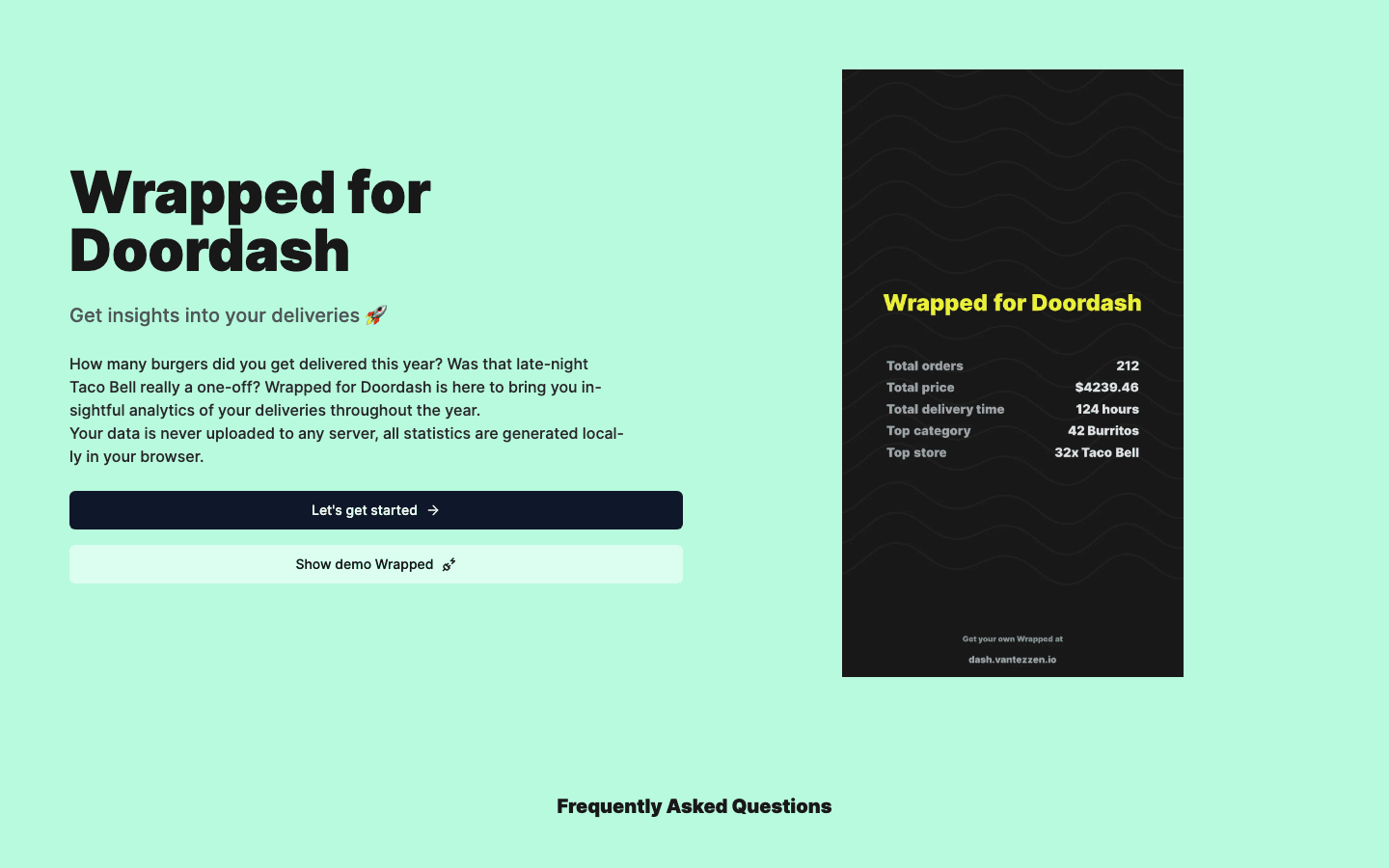
Wrapped for DoorDash shows your last year of food deliveries as a short story in the style of Spotify Wrapped: what you spent, how long you waited and where you ordered most.
The story has eight slides, each with its own song from Spotify’s embed player:
- An intro that sets up the year
- Your total spend, with a comment that scales with the amount, from “A single dollar? Was it for a candy?” to “DoorDash devotee status: unlocked.”
- The total time you spent waiting for deliveries
- What you could have done in that time instead, such as cooking a homemade meal or learning a new language, “but you were probably just on your phone”
- The weekday you order most
- Your top store and how often you ordered there
- Your most ordered category
- A roundup with all numbers on one card
The roundup can be saved as an image in story format.
How it works
DoorDash lets you export your order history from the app (Profile, then Order History, then Export Order Data). You get a file called DoorDashOrders.zip and drop it onto the site. The rest happens in your browser:
- JSZip unpacks the archive
- PapaParse reads
consumer_order_details.csv, which lists every item you ordered as its own row - Rows with the same timestamp are grouped into one order, and only the last twelve months are kept
- Delivery time is the difference between order time and delivery time. Pickup orders are left out of that number.
Your order history is never uploaded to a server. The statistics, slides and summary image are all generated on your device.
Why it exists
After Wrapped for TikTok took off, the format turned out to work for any service that lets you export your data. DoorDash was an obvious candidate: people order a lot, rarely add it up, and the export contains exact prices and timestamps.
What happened
The app reuses the TikTok Wrapped architecture: the same story player, statistics classes, per-slide music and share image route. Only the parsing and the statistics are new, so it took a single day to build in November 2023. The source code is MIT licensed on GitHub.
The same approach produced other Wrapped apps for Apple Health, Instagram and Hinge. Each one only needs a parser for the service’s export format and a new set of statistics and slides.