
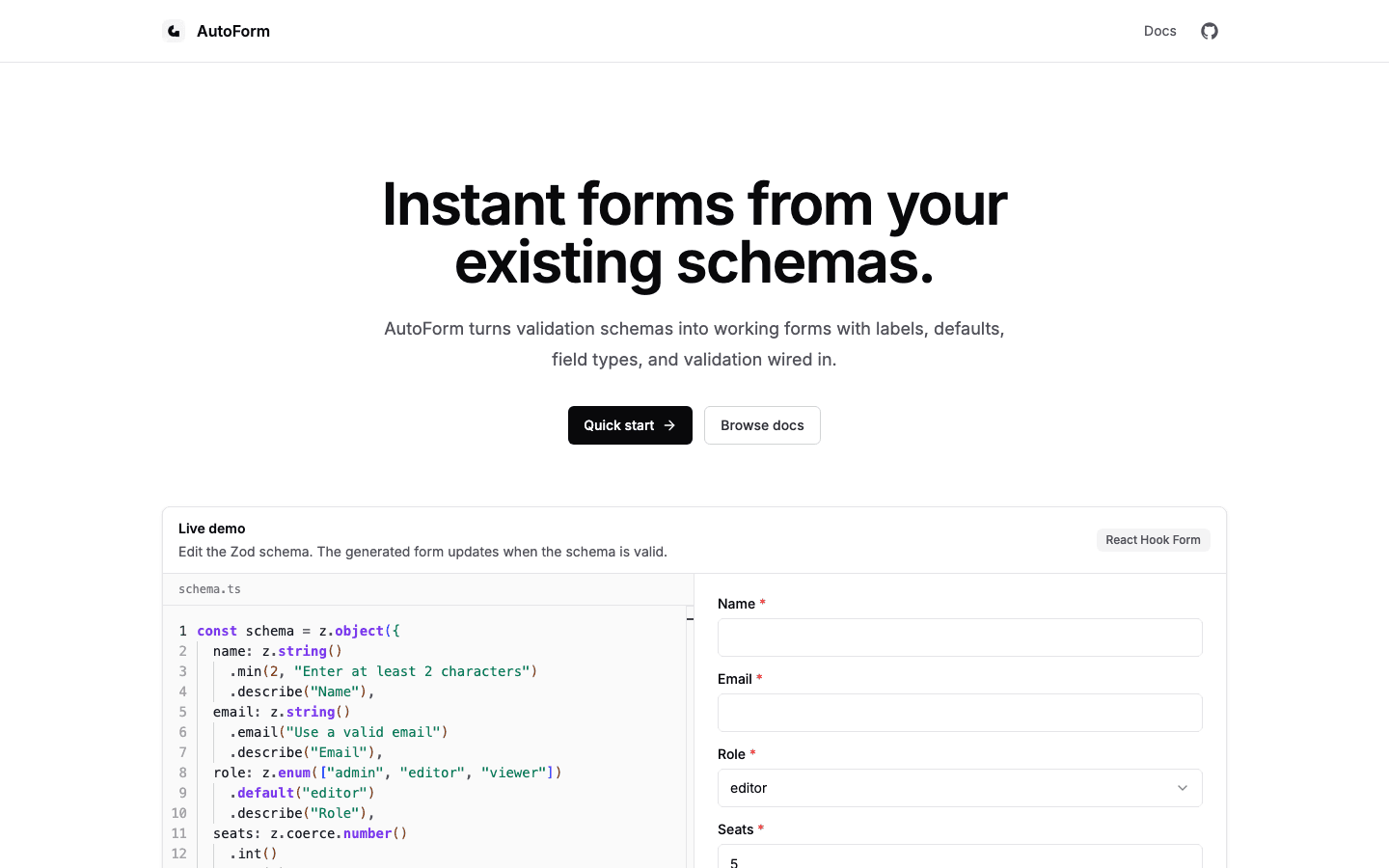
What it is
AutoForm renders a complete React form from a validation schema you already have. You pass it a Zod, Yup or Joi schema and get labeled inputs, default values, field types and validation messages, styled with the UI library your project uses. It is meant for internal tools, admin panels and settings pages: places where the data shape is already defined on the backend and writing every input by hand adds nothing.
import { z } from "zod";
import { ZodProvider } from "@autoform/zod";
import { AutoForm } from "@autoform/mui/react-hook-form";

const schema = new ZodProvider(
  z.object({
    name: z.string(),
    birthday: z.coerce.date(),
    email: z.string().email(),
  }),
);

<AutoForm schema={schema} onSubmit={console.log} withSubmit />;
AutoForm does not try to be a full form builder. When a form needs a custom layout or complex conditional logic, you write that form yourself. For the many forms that only mirror a schema, AutoForm replaces a few hundred lines with one component.
How it works
The library is split into four layers, each published as its own package, so a project only installs the parts it needs:
- Schema provider (
@autoform/zod,yup,joi): walks the schema and turns it into a plain tree of fields with a key, type, required flag, default value, description and options. - Core (
@autoform/core): label generation, defaults and validation. It contains no React and no UI code. - Form adapter (
@autoform/react): binds every field to React Hook Form or TanStack Form. - UI package: maps field types to components of a design system. Packages exist for shadcn/ui, MUI, Mantine, Ant Design and Chakra.
Adding a new UI library means implementing a handful of components such as a text input, a checkbox and a select. A custom adapter fits in about a hundred lines. Per-field options (label overrides, input props, field order, a different field type) are attached to the schema as metadata, so the schema stays the single source of truth.
The monorepo is built with Turborepo, tested with Cypress component tests and released with Changesets.
Why it exists
Admin forms kept being wired up by hand for schemas that already existed on the backend. Every field meant a label, an input, an error message and a default value that had to stay in sync with the schema. In July 2023 AutoForm started as a single shadcn/ui component that read a Zod schema and produced the form. People copied it into their projects, and pull requests for textareas, nested objects, arrays and field dependencies followed within weeks.
What happened
The component outgrew its copy-and-paste origins. In October 2024 it was rewritten as a standalone library that is independent of both the schema library and the UI library, and released as AutoForm v2. Since then the project added Mantine, Ant Design and Chakra integrations, Joi support, Zod 4 support and, in July 2026, an adapter for TanStack Form alongside React Hook Form. The repository also ships a skill that teaches AI coding agents how to use the library.
AutoForm has around 3,500 stars on GitHub, contributions from 29 people, and about 150,000 npm downloads per month for @autoform/react alone. Over the twelve months to July 2026 it was downloaded about a million times.