
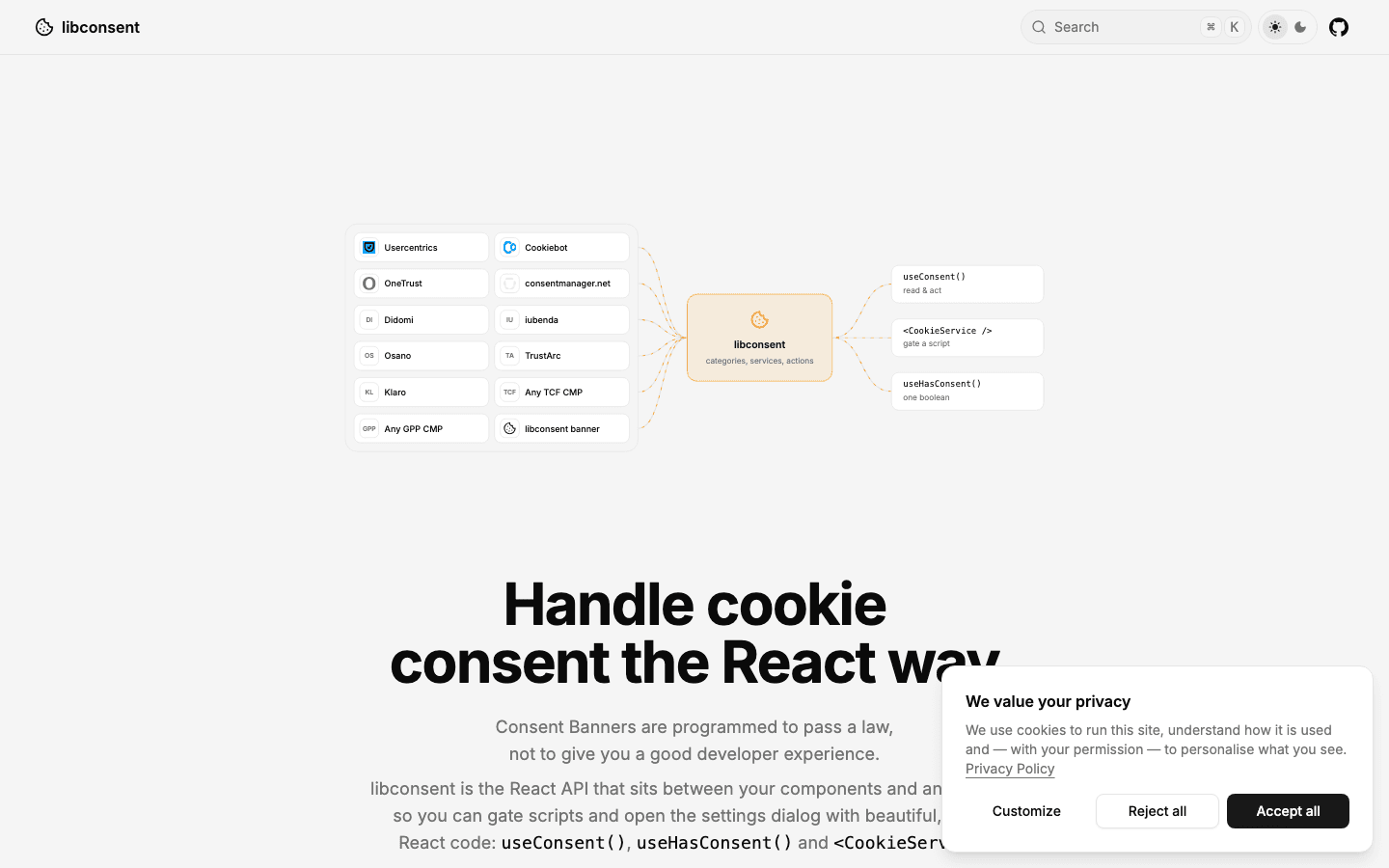
What it is
libconsent gives React apps one API for cookie consent, whichever consent banner runs on the page. Components ask a single question, such as whether marketing cookies are allowed, and libconsent translates it to the consent platform you use.
import { ConsentProvider, CookieService } from "@libconsent/core";
import { usercentrics } from "@libconsent/usercentrics";

<ConsentProvider adapter={usercentrics({ settingsId: "AbCdEf123" })}>
  <CookieService id="google-analytics">
    <GoogleAnalytics gaId="G-XXXXXXX" />
  </CookieService>
</ConsentProvider>;

// Anywhere below the provider:
const ads = useHasConsent("marketing");
The consent platform is named in exactly one place, the adapter passed to ConsentProvider. Switching from Cookiebot to OneTrust is a one-line change.
How it works
Every consent management platform (CMP) exposes consent differently. With OneTrust you poll window.OnetrustActiveGroups for a group ID like C0004 and hook into OptanonWrapper. Cookiebot needs four window events and window.Cookiebot.consent.marketing. libconsent wraps each of these in an adapter of 100 to 200 lines that maps the platform’s state to four categories: essential, functional, analytics and marketing.
Adapters exist for:
- Usercentrics, Cookiebot, OneTrust, Didomi and iubenda
- Osano, TrustArc, consentmanager.net and Klaro
- The IAB TCF v2.2 standard, which covers Google’s CMP, Sourcepoint, Quantcast Choice and others
- The IAB GPP standard for US state privacy signals, including Global Privacy Control
Projects without a consent platform can use the built-in local mode, which stores the choice in the browser. A ready-made consent banner installs as a shadcn/ui registry item with one command. libconsent also writes Google Consent Mode v2 signals from the same state, unless the CMP already does.
A built-in catalog describes common services such as Google Analytics with their category and the name each consent platform uses for them. Wrapping a script in CookieService renders it only after consent and registers it in the consent dialog, so the list of services shown to visitors stays in sync with the code.
On the server nothing counts as consented, so the server render and the first client render always match and hydration stays stable. The choice can be stored in localStorage or in a cookie that middleware and server components can read. The core has no runtime dependencies and supports React 18 and 19.
Why it exists
Consent banners are built to satisfy a law, not to be pleasant to program against. Each one has its own globals, events and category names, and code that depends on them breaks when a company switches vendors. The same glue code to check whether a script may run kept coming back in every project. libconsent is that glue code as a library.
Where it is now
libconsent was published in August 2026 as version 0.1.0, with the core package and eleven adapters on npm under the @libconsent scope. It is built with Bun workspaces, Turborepo and Changesets, the same setup as AutoForm, and documented with a live demo on GitHub Pages. It is a young project: feedback from people running it against their own consent platform is the most useful contribution right now.