
What it is
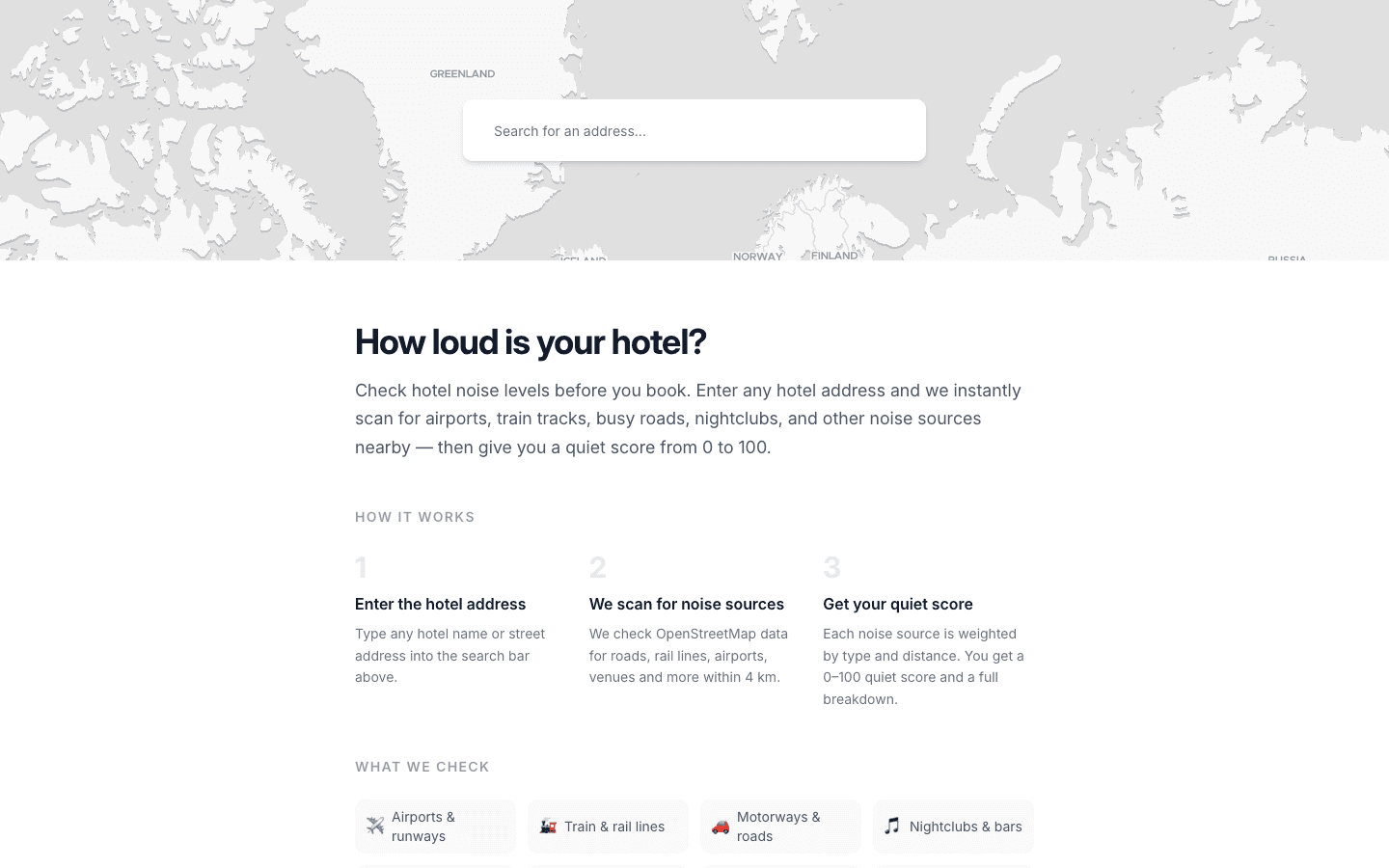
How loud is my Hotel scores how noisy a hotel, Airbnb, apartment or potential new home is likely to be. You enter an address and get a quiet score from 0 to 100, where higher means quieter. A map shows every noise source that went into the score, with separate scores for day and night.
How it works
Finding noise sources
All data comes from OpenStreetMap. Address search uses Nominatim, and noise sources come from six queries to the Overpass API, each with its own radius:
- Nightlife such as bars, clubs and beer gardens: 150 m
- Major roads: 200 m. Railways, trams and stations: 300 m
- Fire stations, police and hospitals: 600 m
- Stadiums, venues, markets, schools and places of worship: 200–500 m
- Construction sites and industrial areas: 250–400 m
- Airports, runways and helipads: 4 km
Scoring
Each source gets a base weight by category, adjusted with its OpenStreetMap tags. A motorway counts more than a secondary road, more lanes and higher speed limits add weight, and tunnels count for almost nothing. An S-Bahn line counts less than an intercity line.
The weight then decays with distance. Low-frequency noise from trains and aircraft carries far, so it decays slowly. Bar noise drops off within a block, so it decays fast. A railway line that is mapped as many segments only counts once, at its closest point.
Every source also has a time profile. A motorway is loud around the clock, a bar is loud at night, and a stadium is loud only on event days, so it counts for a quarter of a constant source. These profiles produce the separate day and night scores and caveats such as temporary construction.
The final 0 to 100 score is calibrated against all hotels in the database. A score of 90 means the location is quieter than about 90% of tracked hotels.
Caching and privacy
The first lookup of a place queries OpenStreetMap and takes a few seconds. The result is stored, so every later visit loads instantly and the public OpenStreetMap services are not queried again. Only real accommodation is listed publicly on city pages. If you look up your own home, the result is cached but never listed and hidden from search engines.
Why it exists
Booking sites show where a hotel is, but not how close it is to the next railway line or nightclub. OpenStreetMap has that data, so a score can be computed before you book.
What happened
The tool launched in June 2026. City pages rank about 250 hotels across 40 cities, including London, Paris, New York and Tokyo, by quiet score. The same engine powers separate pages for checking an Airbnb, an apartment or a new home before you sign a lease.
It is built with TanStack Start, Drizzle and Postgres, and the map uses deck.gl on top of MapLibre.