
What it is
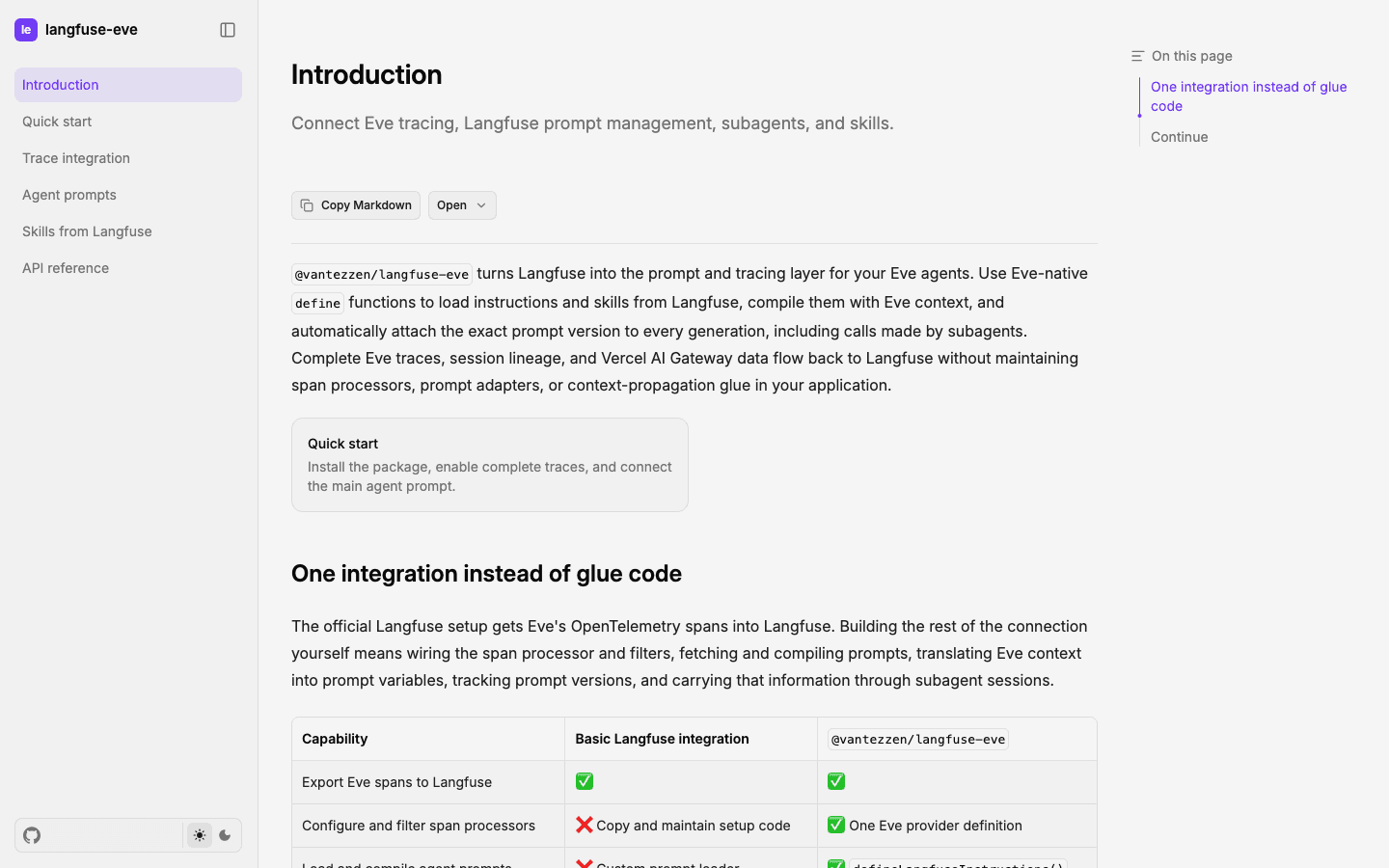
langfuse-eve connects AI agents built with Eve to Langfuse. Eve is Vercel’s open source framework for durable backend agents, where an agent is a folder of files for instructions, skills, subagents and instrumentation. Langfuse is an open source platform for LLM tracing and prompt management.
The basic Langfuse setup only exports Eve’s traces. langfuse-eve makes Langfuse the place where the agent’s prompts live as well:
- Instructions are loaded from Langfuse prompts at runtime
- A folder of Langfuse prompts becomes a set of Eve skills
- Every model call is linked to the exact prompt version that produced it, including calls made by subagents
- Subagent traces are grouped under the root session
- Vercel AI Gateway generation IDs and costs are recorded
How it works
The package exposes three define functions that follow Eve’s file conventions. Each one goes into the matching folder of the agent:
// agent/instrumentation/langfuse.ts
import { defineLangfuseInstrumentation } from "@vantezzen/langfuse-eve/instrumentation";
export default defineLangfuseInstrumentation();

// agent/instructions/identity.ts
import { defineLangfuseInstructions } from "@vantezzen/langfuse-eve/instructions";
export default defineLangfuseInstructions("agents/support", {
  fallback: "You are a concise support agent.",
  label: "production",
});

// agent/skills/company.ts
import { defineLangfuseSkills } from "@vantezzen/langfuse-eve/skills";
export default defineLangfuseSkills("skills/company", { tag: "skill" });
Instructions are compiled with variables from Eve’s context before they reach the model. If Langfuse is unreachable, the agent uses the local fallback text, so a tracing outage never takes the agent down. Skills are read from a Langfuse prompt folder, and each prompt’s frontmatter provides the description Eve uses to decide when to load it.
For tracing, the package builds on Eve’s OpenTelemetry pipeline and the official Langfuse span processor. It maps Eve’s spans to Langfuse observation types:
- Model calls become generations
- The root agent and each subagent become agent observations
- Tool and skill calls become tool observations
- Memory lookups become retriever observations
The session ID is the root Eve session, so a conversation that fans out into several subagents shows up as one tree in Langfuse. The whole package is about a thousand lines of TypeScript with Bun tests and a demo agent that delegates to a researcher subagent.
Prompts in Langfuse carry labels such as production or latest. Pointing a development environment at latest and production at production gives prompts their own release cycle: a change can be tested in a preview deployment and promoted without touching the agent’s code.
Why it exists
Teams building agents with Eve often keep their prompts in Langfuse, so prompts can change without a deploy. The official setup leaves you to write span processors, prompt loaders, context adapters and subagent propagation yourself. Without prompt-version attribution you cannot tell which prompt change caused a regression. langfuse-eve packages that integration layer so it is one dependency instead of a folder of glue code in every agent.
Where it is now
langfuse-eve 0.1.0 was published to npm in September 2026 as @vantezzen/langfuse-eve, with documentation on GitHub Pages. Eve itself is still evolving quickly, so the package tracks its releases and the API may change before 1.0.