
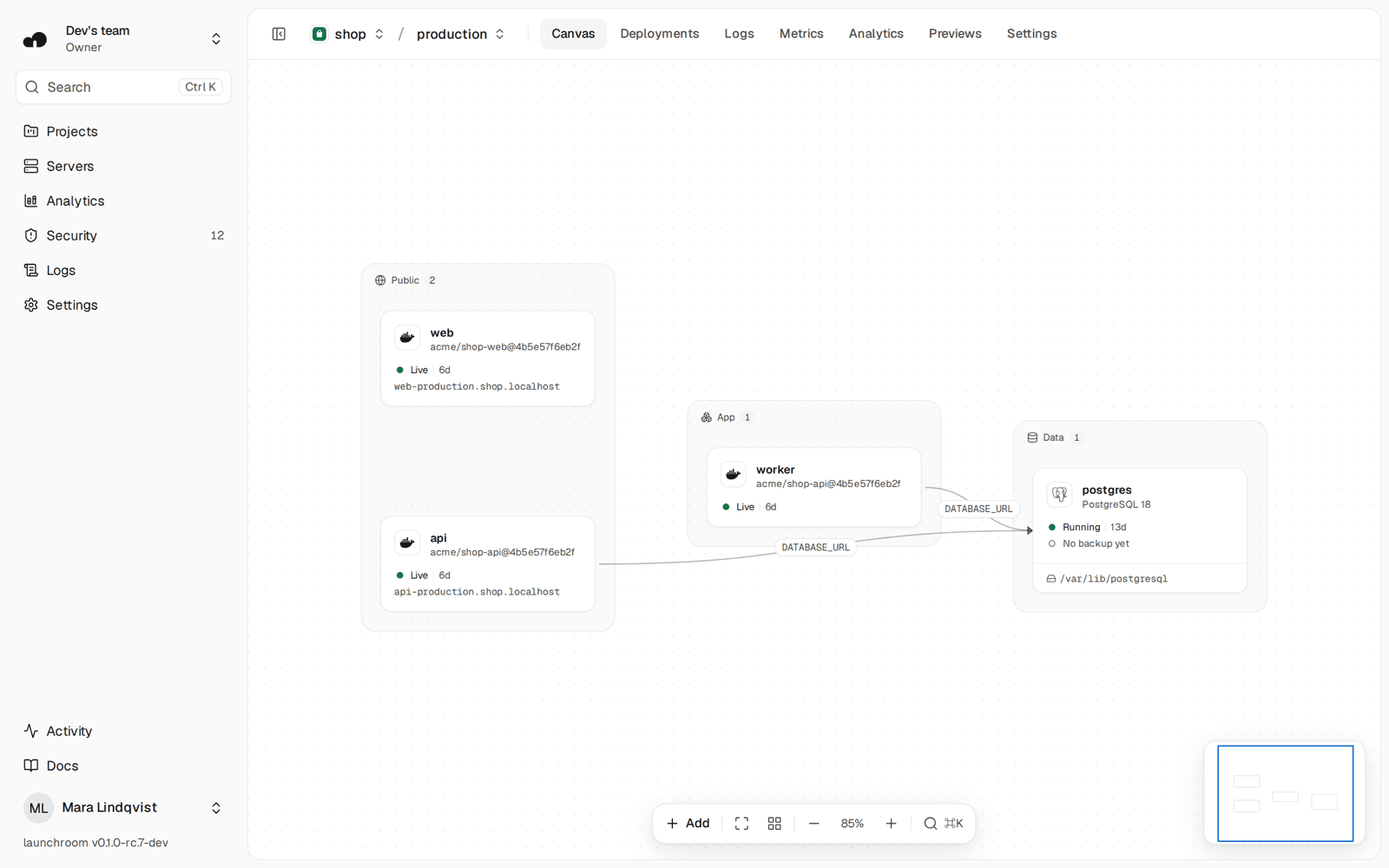
What it is
launchroom is a self-hosted deployment platform. It gives your own server the workflow of a managed host like Vercel or Railway: pick a repository, a domain and a database, and launchroom builds the app, gets the TLS certificate, passes it the database credentials and deploys every push without downtime. It is free and MIT licensed, with every feature included and no account required.
curl -fsSL https://launchroom.vantezzen.io/install | sh -s -- --domain dash.example.comFeatures include:
- Builds without a Dockerfile for Next.js, Laravel, Django, FastAPI, Node and static sites
- Managed Postgres, MySQL, Valkey, MongoDB and ClickHouse, with backups to your own S3 bucket
- A preview deployment with its own database for every pull request
- Health-checked rollouts and instant rollback
- More servers joined with one command over a private WireGuard mesh, including a home machine that builds images for a small VPS
How it works
launchroom has two parts. The control plane is the dashboard: a Laravel 13 and React 19 app on FrankenPHP, with Postgres as the source of truth, queue workers for the deployment state machine, websockets for live updates and a private container registry.
Every server runs launchroomd, a small Go daemon. The dashboard never logs into servers over SSH. Instead, a deploy freezes the staged changes into an immutable revision, a scheduler decides which server runs what, and each server receives a signed, versioned description of its desired state. The daemon pulls that state over mutually authenticated HTTPS and reconciles Docker, the Caddy reverse proxy and the firewall until reality matches it. Builds run in rootless BuildKit with Railpack.
This design means apps keep running when the dashboard is down, and it avoids building shell commands from strings, which is the source of many security bugs in comparable tools.
Why it exists
Most vantezzen projects run on their own servers. Existing self-hosting dashboards felt like a cheaper step down from managed platforms: the deploy experience was worse, and rollbacks or previews were missing or fragile. launchroom’s guiding principle is that it should be the best place to deploy, which happens to run on your own hardware.
Before any code was written, the source of Coolify and Dokploy was studied for what to avoid: SSH with shell strings, mounting the Docker socket in the dashboard, routing through container labels, rollbacks to :latest, and marking a deploy successful before it is healthy. The design documents run to more than 7,000 lines and a log of over sixty architecture decisions.
Where it is now
A first version in 2025 was a simpler Laravel tool for Next.js and Laravel apps. The current launchroom is a full rewrite, released as public release candidates in October 2026. Releases are signed with cosign and the installer verifies the signature before running. Expect rough edges until 1.0.